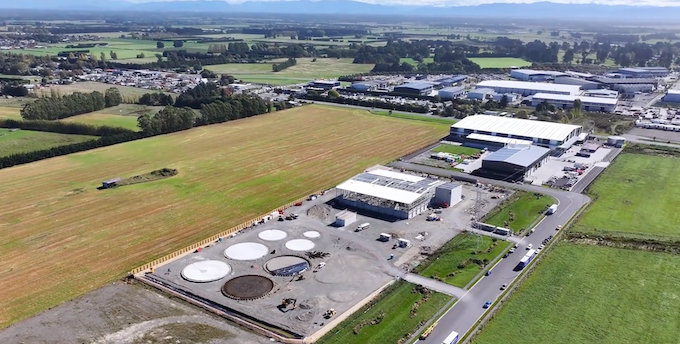
Located in the central North Island, the Ecogas Organics Processing Facility operates as New Zealand’s pioneer large-scale commercial food waste-to-bioenergy plant. Acting as a circular economy hub, the facility turns organic waste into renewable energy, biogenic carbon dioxide and bio-fertilisers.
The EcoGas facility processes up to 75,000 tonnes of organic waste annually, sourcing inputs from commercial food manufacturers and municipal collection schemes like Auckland City Council’s Rukenga Kai kerbside food waste collection. Built as a joint venture between Pioneer Energy and EcoStock Supplies, project construction was backed by a $7 million loan from the New Zealand government Provincial Growth Fund alongside Ministry for the Environment support.
Using large-scale anaerobic digestion, an oxygen-free biological process driven by microorganisms, the site captures harmful methane emissions that would otherwise escape from open landfills into the atmosphere. The plant generates approximately 160 terajoules of energy annually. In partnership with gas infrastructure provider Clarus, raw biogas is purified into biomethane. In a huge project milestone and a first for New Zealand, injection of biogas directly into the national gas grid has recently commenced. Thermal energy and biogenic CO₂ are diverted directly to heat and nourish crops in nearby commercial tomato glasshouses. The nutrient-dense liquid digestate remaining after processing is then converted into Fertify, a bio-fertiliser applied across local farms to replace imported synthetic nitrogen and phosphate. A welcome development in a nation where tensions remain between agricultural intensification and public concerns over rural water quality.
Although utilising imported componentry, the plant relies on local scientific research for validation and compliance. University of Auckland researchers worked alonside the project to help formulate the pasture-safe digestate to be used as fertilizer. Toitū Envirocare (a Bioeconomy Institute spin-out) verified life-cycle carbon flow. The project also received funding from the Bioresource Processing Alliance, a collaboration between the Bioeconomy Institute and universities. The funding was directed towards optimising value-added products and satisfying regional council soil application standards. Additionally, the site functions as an active demonstration bed for local clean-tech ventures, including organic-waste processing startup Cetogenix. With the success of the initial EcoGas development, a second gas-to-grid biomethane project is now under construction for the city of Christchurch.
Genius ReFi connects researchers, entrepreneurs, investors and industry to build high value science-based ventures.
Join our mailing list or participate in the free Genius ReFi innovator community on Discord.