
Two years ago European investors were all in on green tech. But squeezed between political chaos to the West and a brutal war to the East, the investment landscape has shifted. A realignment of investor and sovereign interests across Europe has led to an emerging renaissance in deep tech. It could represent a big opportunity for canny science researcher entrepreneurs – including some from outside Europe.
Geopolitical ructions conspired to force the rethink. A protracted conflict on the doorstep of Europe has softened previously cautious attitudes toward defence related investments. Increasing protectionism, tariff pressures, not to mention overt challenges to trans-Atlantic alliances, have also been a wake-up call for Brussels. Europe has finally recognised that it can no longer outsource its security umbrella or its foundational technology stack to the United States. Supply chain vulnerabilities, war related energy security shocks and the urgent need to fund defence capability have all conspired to divert attention away from long-horizon green infrastructure projects.
So after a dream run of green tech fund raising in 2024, European venture capital underwent a dramatic structural pivot in 2025. Driven by mounting defence concerns and a mercurial political leadership across the Atlantic, investors (and governments) began re-evaluating where to place their bets. For nearly a decade, European funding priorities were anchored heavily in sustainability and digital SaaS. However, according to recent data from Sifted, European deep tech funding surged by 61% to €13.5bn in 2025, while green and climate tech investments plummeted by 37%. Green tech may be down, but it is not out, having secured a total of €17.0bn. But the paucity of follow-on funding for Series B and growth stages remains a perennial problem for green tech.
With late-stage deep tech highly vulnerable to being acquired by foreign interests or moving abroad to scale, European state backers have now ramped up funding programs aimed at preserving tech sovereignty. A cornerstone of this strategy sits with the EU version of the Chips Act. Its primary goal is to bolster Europe’s security of supply, competitiveness, and technological sovereignty in semiconductors. The aim is to double the EU’s global market share of chip production from roughly 10% to 20% by 2030. The initiative includes more than €11Bn in public funding focused on bridging the gap between “lab and fab.” It funds deep-tech research, builds next-generation prototyping, establishes quantum chip development and establishes an open access cloud-based design platform.
Institutional co-investment vehicles such as the €1B+ NATO Innovation Fund and the €5bn Scaleup Europe Fund (launching this week) have also awoken investors to the co-investment possibilities for dual-use civil/military deep tech such as autonomous robotics, new materials and cyber-security tools. Defence and security startups absorbed 43% of all European deep tech funding in 2025.
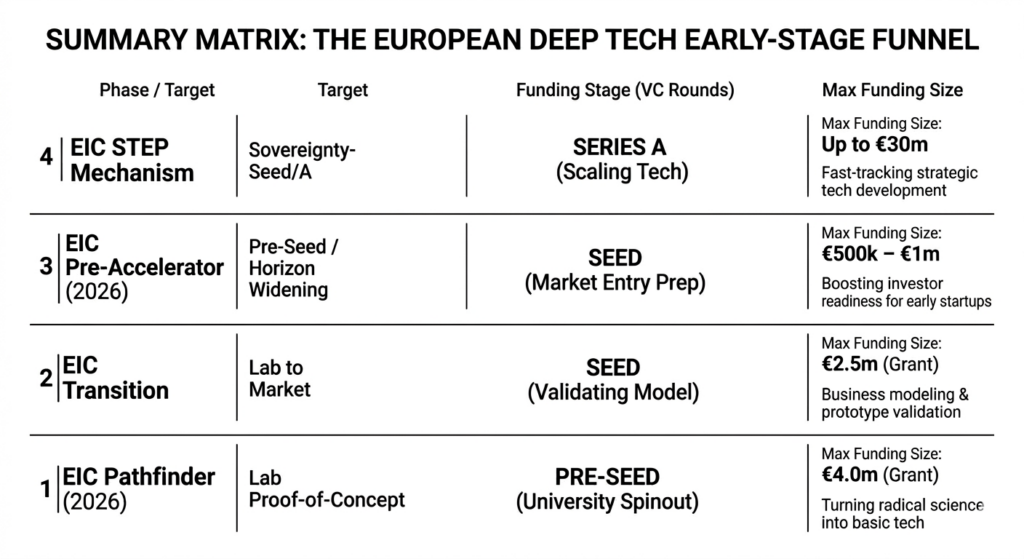
So where does this leave founders and what future is there for regenerative science based ventures in Europe? Happily there are numerous bright spots for science based innovators, even outside of “dual use” technologies. There are also a number of freshly replenished early stage funds designed to support science and engineering research commercialisation. The Pathfinder and Transition funds are non-dilutive. See below:
In Part II of this article, we will look at European innovation bright spots outside of defence and consider venture pathways for scientist entrepreneurs who reside out of the EU.
Genius ReFi connects researchers, entrepreneurs, investors and industry to build high value science-based ventures.
Join our free Genius ReFi Discord community.
Image credit: Renea Mackie